“Live timing is the new standard, even for grassroots races.”
Today’s race participants and fans expect instant updates. Modern timing systems let anyone follow the action in real time. As RunSignup’s RaceJoy notes, “Participants and spectators now expect some form of tracking [to] be made available for most events”. Offering live results can dramatically improve the race-day experience: timing experts observe that prompt, accurate results “enhance the quality of race experience for participants” and that “happy participants [result in] satisfied race organizers”. By contrast, organizers agree that nothing hurts an event more than slow or wrong results .
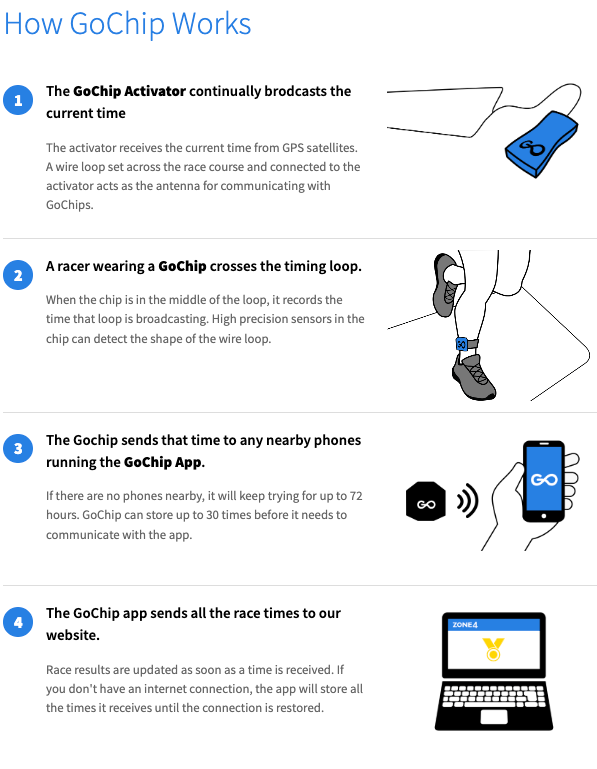
Figure: Example race timing equipment diagram
In practice, a typical live-timing system uses RFID tags (on bibs or ankle bands) and mats at the finish and splits. The tags store each pass and transmit it back to a central controller (sometimes via a mobile internet link) . Specialized scoring software then compiles these times into overall and category results on the fly. The result is that as each runner crosses a timing point, their name and split appear immediately on the live leaderboard or race website. For example, Zone4’s GoChip system and software offer “live online results” and even location prediction of racers . Timing providers like RaceResult and ChronoTrack similarly support live-result feeds into phones and displays .
Key Benefits of Live Results:
- Smoothed logistics and planning. Real-time timing data lets directors monitor race flow and spot bottlenecks instantly. Splits at aid stations or checkpoints reveal where congestion occurs, so crews can be redeployed during the race or improve the course for next time. Over time, analyzing live timing (“an entire road map for improvement” ) helps refine course design, volunteer deployment, and safety plans. Race organizers can also mine split-time data to tweak cutoff times, plan future race-day staffing, and report impressive stats in marketing (e.g. “60% of our runners set PRs this year”).
- Better runner experience. Athletes love instant feedback. Seeing one’s name and finish time online right away boosts satisfaction and excitement. Race Timing Solutions emphasizes delivering “results that enhance the quality of race experience for participants”. In practical terms, clubs using live timing report smooth operations and grateful runners: one triathlon director said “athletes and spectators really appreciated having real-time results available at the venue and online,” and that the event “went smoothly” using Zone4 . Participants can track their pace as they go and immediately share their performance, reducing post-race anxiety. Providing fast, accurate results also makes the awards ceremony more efficient and drama-free.
- Greater spectator and sponsor engagement. Live results keep friends, family, and media involved. Spectators at the race or watching remotely can follow leaderboards and split times as they happen, which keeps excitement high. Timing companies market these systems specifically for engagement: one media partner notes that live splits and dynamic leaderboards “keep spectators, announcers, and participants connected throughout the race” . Likewise, apps like RaceJoy turn every smartphone into a cheering tool (fans can send audio “cheers” to runners), while leaderboards and maps display sponsor logos with every update. Organizers report that offering a “big race experience” through live tracking (at modest cost) makes events feel more professional . In short, sponsors get more visibility (e.g. on race apps or results emails), and the community buzz around the event grows, benefiting future participation and fundraising.
Common Pitfalls to Avoid:
- Technical and power failures. Live timing hinges on hardware and connectivity; if either fails, results grind to a halt. Common culprits include dead batteries, unreliable power sources, or damaged equipment. Timing experts warn that “fluctuations in city grid power can lead to system unreliability” , so organizers should use stable generators or backups for antennas and readers. Similarly, most systems send times over cellular or Wi-Fi. In remote or rugged trail races, where connectivity is poor, choose systems that buffer times offline (for example, Zone4’s GoChips store splits on the chip until the finish ).
- Overlooking backups. Because timing is so critical, reduncancy is essential. Industry best practices (e.g. CARA guidelines) require a backup timing system and power plan . This might mean keeping a second timing kit or a manual timer on standby, plus an extra generator or battery. In one notorious case (the 2017 Mexico City Marathon), organizers had to disqualify thousands of runners due to missed chip reads – a fiasco that commentators warned would make people “not trust any of the results” . Having a fail-safe (like video backup or manual scoring) can prevent that kind of damage to your event’s reputation.
- Poor equipment setup or tagging. Even when power and internet are fine, setup mistakes can cause missing or duplicate reads. Careless handling of antenna cables, or placing mats improperly, can lead to invisible runners. For example, RFID antennas must be oriented and placed per spec (height and staggered LH/RH) to catch every tag . Likewise, athletes must be instructed on wearing chips correctly; folding or overlapping a tag can block the signal . Before race day, test your system on every bib and mat. Also remember that weather (heavy rain or mud) can occasionally short-circuit mats. Even a few missed splits or a late update can spark confusion or protests from runners.
- Lack of education. Finally, don’t assume participants or staff know how live timing works. Advertise how to access results (e.g. a mobile app or website URL) before the race and remind runners at the start. Brief timing team members and volunteers on procedures (e.g. correct starting/stopping of the race clock ). If runners don’t know to check the live feed or misinterpret split times as final results, they can be unnecessarily anxious or disappointed. Clear pre-race communication and simple instructions can save headaches.
Impact on Runner Experience and Event Reputation: When done right, live results make runners feel seen and excited. Participants frequently remark how impressed they are: one club manager said “everyone seemed to be impressed as to how quickly results could be posted”. Quick, accurate results let runners brag or plan post-race strategy (like checking final standings). A transparent, smooth system builds trust: runners will happily return to an event where results are reliable.
By contrast, poor timing can sour memories. Tortoise & Hare Timing bluntly states that “nothing is more detrimental to a race than having inaccurate or delayed results”. Any high-profile timing error can do lasting damage. (As one expert put it after the Mexico City marathon fiasco, if thousands of finishers were disqualified due to a timing glitch, people might “not trust any of the results” .) Race directors must therefore realize that live results are a double-edged sword: they can amplify an event’s prestige when successful, but rapidly tarnish reputation if the timing system fails.
Leveraging live timing well requires choosing the right tools and preparing rigorously. Most modern platforms—whether Zone4’s affordable system or enterprise solutions like MyLaps and ChronoTrack—have robust live-result features, but even the best tech needs power, connectivity, and human care. By anticipating pitfalls and educating participants, race directors can harness live results to streamline operations, thrill runners and fans, and ultimately enhance their event’s reputation . In today’s race community, live results have become part of what makes an event feel professional and engaging – “a big race level of experience” even at smaller events . .
 blog.zone4